

How Can an Auto Rewinder Enhance the Quality of Your Finished Rolls
2026-03-05
In the web converting and flexible packaging industries, achieving superior roll quality is directly linked to the precision of your finishing equipment. An Auto Roll To Roll Rewinder is not merely a machine for transferring material; it is a critical tool for quality assurance. At Weiju, we understand that the difference between a standard roll and a premium finished product lies in the technology behind the winding process. By integrating an Auto Roll To Roll Rewinder into your production line, you can significantly reduce defects, ensure consistency, and meet the stringent demands of modern clients.
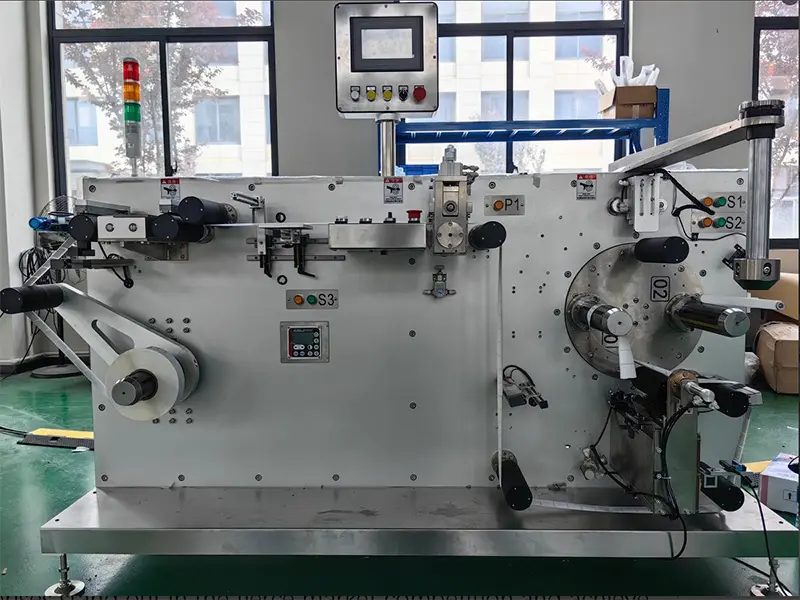
The Direct Impact of Automation on Roll Integrity
When discussing quality, we must address the physical attributes of a finished roll: edge alignment, tension uniformity, and telescoping prevention. Manual or outdated rewinding systems introduce human error and mechanical inconsistency. Here is how a modern Auto Roll To Roll Rewinder solves these issues:
| Quality Parameter | Challenge with Manual Rewinding | Solution with Weiju Auto Rewinder |
|---|---|---|
| Tension Control | Inconsistent tension leads to telescoping or crushed cores. | Closed-loop servo control maintains precise tension from core to finish. |
| Edge Alignment | Wandering edges create waste and require edge trimming. | High-accuracy EPC (Edge Position Control) ensures laser-straight edges. |
| Surface Condition | Speed variations cause scratches or wrinkling. | Synchronized speed matching prevents web distortion and surface marring. |
| Roll Density | Variable hardness affects downstream application. | Programmable pressure profiles allow for tapered or constant gap winding. |
By utilizing a Weiju Auto Roll To Roll Rewinder, converters report a drastic reduction in "popcorn" rolls and rejected materials, directly enhancing the final product's marketability.
Key Features That Drive Quality
To truly enhance quality, the equipment must offer more than just speed. The Auto Roll To Roll Rewinder from Weiju incorporates specific technologies designed to protect and perfect the web material.
-
Intelligent Tension Profiling: Automatically adjusts tension based on roll diameter growth, preventing "blocking" in film layers.
-
Contact or Gap Winding Modes: Allows operators to switch between hard winding (for slip-resistant rolls) and soft winding (for delicate materials) without mechanical changeovers.
-
Real-Time Defect Detection: Integrated sensors can flag irregularities during the rewinding process, ensuring only perfect material makes it to the finished roll.
Frequently Asked Questions About Auto Roll To Roll Rewinders
To provide a deeper understanding of how this technology safeguards quality, here are answers to common inquiries regarding the Auto Roll To Roll Rewinder.
Q: How does an Auto Roll To Roll Rewinder prevent damage to sensitive materials like thin films or laminates?
A: Sensitive materials require meticulous handling to avoid stretching or deformation. A high-quality Auto Roll To Roll Rewinder, such as those manufactured by Weiju, utilizes ultra-low inertia rollers and precision servo drives. This configuration ensures the web accelerates and decelerates smoothly without jerking. Furthermore, the system maintains a constant surface speed ratio between the winding roll and the driven rollers. This prevents slippage, which is the primary cause of scratches and static buildup, thereby preserving the optical and mechanical properties of sensitive films.
Q: Can upgrading to an Auto Roll To Roll Rewinder reduce waste caused by telescoping?
A: Absolutely. Telescoping—where the layers of a roll slide sideways—is often a result of improper tension or misalignment. An Auto Roll To Roll Rewinder combats this through a dual-action approach. First, the automatic tension control system maintains a steady force on the web, preventing the slack that leads to wandering. Second, the integrated Edge Position Control (EPC) actively tracks the edge of the material and shifts the rewinding carriage to keep the edge perfectly stacked. Weiju's advanced EPC systems can correct misalignments in milliseconds, virtually eliminating telescoping and significantly reducing material waste.
Q: What role does operator skill play when using an advanced Auto Roll To Roll Rewinder?
A: One of the primary benefits of automation is the democratization of quality. While a skilled operator is always valuable, an Auto Roll To Roll Rewinder reduces dependency on manual expertise. With Weiju's intuitive HMI (Human-Machine Interface), operators simply input the material type, width, and desired roll diameter. The machine's PLC then automatically calculates and executes the optimal winding recipe, including taper tension and nip pressure. This ensures that every shift produces identical high-quality finished rolls, regardless of who is operating the machine.
Conclusion: Elevate Your Standards with Weiju
The quality of your finished rolls is the final impression you leave on your customer. Inconsistencies, edge wander, and poor winding tension can undermine the quality of the raw material itself. By investing in a state-of-the-art Auto Roll To Roll Rewinder, you are investing in consistency, efficiency, and a superior product. Weiju is dedicated to providing the engineering excellence required to help you achieve these goals.
Ready to transform your rewinding line and see a tangible improvement in your finished product quality? Contact us today to discuss your specific application and discover how Weiju can engineer the perfect solution for you.