

How Does a Four-High Rolling Mill Reduce Rolling Force Compared to Other Rolling Mill Configurations
2026-04-21
In metal forming, the Four-High Rolling Mill stands out for its ability to significantly lower rolling force compared to traditional two-high or cluster mills. At GRM, we engineer these systems to maximize efficiency while minimizing energy consumption. Understanding the mechanics behind force reduction helps manufacturers achieve thinner gauges with less power.
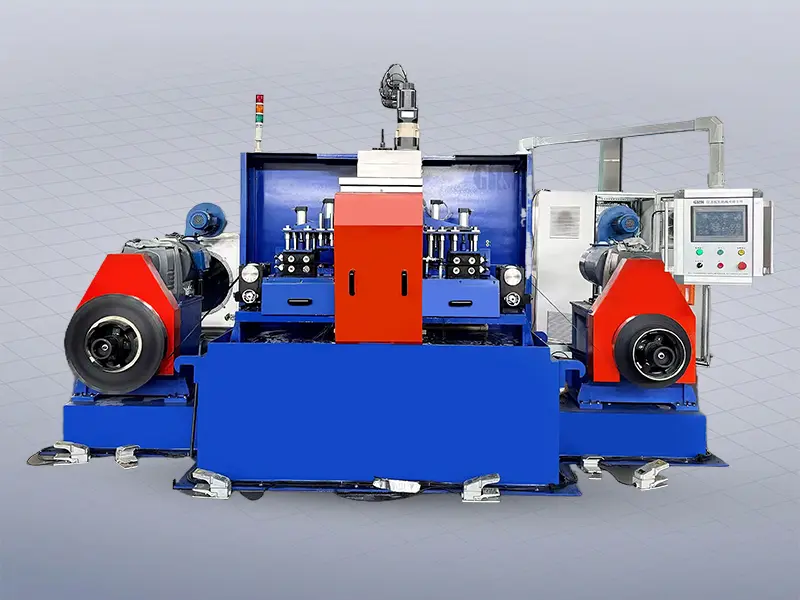
Core Principle of Force Reduction
A Four-High Rolling Mill uses two small-diameter work rolls and two larger back-up rolls. The small work rolls directly contact the metal, reducing the contact area and friction. The large back-up rolls provide stiffness to prevent deflection. This combination lowers the required rolling force by up to 40% compared to a two-high mill of equivalent output.
Comparative Force Requirements
| Rolling Mill Type | Typical Work Roll Diameter | Relative Rolling Force | Best Application |
|---|---|---|---|
| Two-High Mill | 200-400 mm | 100% (baseline) | Thick plates, breaking down |
| Three-High Mill | 150-300 mm | 85-90% | Intermediate rolling |
| Four-High Rolling Mill | 50-150 mm | 55-65% | Thin strips, high precision |
| Cluster Mill | 20-50 mm | 40-50% | Ultra-thin foils |
Why Lower Force Matters
Lower rolling force translates directly to:
-
Reduced power consumption per ton
-
Longer roll life and less frequent regrinding
-
Better thickness tolerance (±0.001 mm achievable with GRM systems)
-
Capability to roll harder materials like stainless steel and silicon steel
Mechanisms Behind Force Reduction
| Mechanism | How It Works in a Four-High Rolling Mill |
|---|---|
| Reduced contact arc | Smaller work rolls shorten the deformation zone |
| Lower friction coefficient | Less surface contact means lower resistance |
| Rigid backup support | Back-up rolls absorb bending forces, allowing work rolls to remain slim |
| Hydrodynamic lubrication | Enhanced oil film formation under lower specific pressures |
Four-High Rolling Mill FAQ
Q: What is the maximum thickness reduction possible in a single pass with a Four-High Rolling Mill compared to a two-high mill?
A: With a Four-High Rolling Mill, a single pass can achieve up to 40-50% thickness reduction for mild steel, whereas a two-high mill typically manages 25-35%. For example, reducing a 2.0 mm strip to 1.2 mm is feasible in one pass using a GRM four-high configuration. The smaller work rolls create lower frictional resistance, allowing the material to elongate more before reaching the roll separation force limit. In practice, aluminum and copper can see even higher reductions—up to 60%—due to their lower deformation resistance.
Q: How does the work roll diameter in a Four-High Rolling Mill directly influence the rolling force value?
A: Rolling force is approximately proportional to the square root of the work roll diameter. A Four-High Rolling Mill with 80 mm work rolls generates roughly half the force of a mill with 320 mm work rolls. For instance, if a two-high mill requires 2000 kN of force to reduce a strip by 30%, a Four-High Rolling Mill with optimally sized rolls might need only 1100-1200 kN for the same reduction. GRM designs use finite element analysis to select the ideal work roll diameter based on material width and target gauge.
Q: Can a Four-High Rolling Mill reduce rolling force enough to permit cold rolling of high-strength steels without intermediate annealing?
A: Yes, in many cases. The reduced rolling force of a Four-High Rolling Mill allows multiple cold reduction passes on advanced high-strength steels (AHSS) with yield strengths up to 800 MPa without immediate annealing. For example, a GRM four-high stand can roll DP600 steel from 3.0 mm to 1.2 mm over three passes at room temperature. By contrast, a two-high mill would likely exceed its force limit after the first pass. However, for ultra-high-strength grades above 1000 MPa, one intermediate annealing step may still be necessary to restore ductility.
Optimization with GRM Technology
Modern Four-High Rolling Mill systems from GRM incorporate hydraulic roll force cylinders, automatic gauge control (AGC), and work roll bending to further reduce force peaks. Real-time force monitoring allows adjustments during rolling, preventing edge cracking and shape defects.
Contact us today to discuss how GRM can engineer a Four-High Rolling Mill solution tailored to your material specifications and production targets. Our team provides force simulation reports and payback analysis for every custom configuration.