

How Does a Self-Healing Shunt Capacitor Improve Power System Reliability?
2026-04-07
Summary: Self-healing shunt capacitors play a crucial role in enhancing the efficiency and reliability of low-voltage AC power systems. This article explores their functionality, advantages, applications, and how Geyue Electric’s designs provide superior solutions for industrial and commercial users.
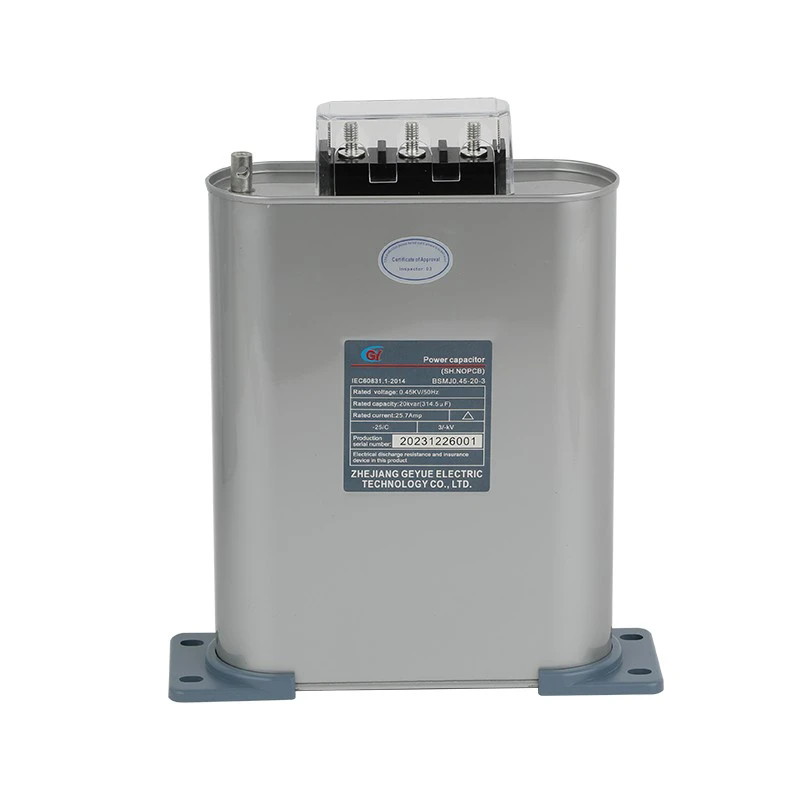
Table of Contents
- What is a Self-Healing Shunt Capacitor?
- How Does It Work?
- Key Advantages of Self-Healing Shunt Capacitors
- Applications in Power Systems
- Maintenance and Longevity
- Frequently Asked Questions
What is a Self-Healing Shunt Capacitor?
A self-healing shunt capacitor is a type of power capacitor designed for low-voltage AC systems, typically 1 kV and below. Its primary role is to improve the power factor, reduce reactive power loss, and stabilize voltage quality in electrical systems. Unlike traditional capacitors, these capacitors automatically restore their function after a dielectric breakdown, ensuring continuous operation.
Geyue Electric specializes in manufacturing high-quality self-healing shunt capacitors with over 15 years of experience, providing reliable solutions worldwide.
How Does It Work?
The unique feature of self-healing capacitors lies in their metallized electrode design. When a dielectric breakdown occurs between the electrodes:
- The surrounding metallized layer evaporates rapidly.
- This evaporation isolates the fault area, effectively "healing" the capacitor.
- The capacitor resumes normal operation without external intervention.
This self-healing mechanism ensures minimal disruption in power systems, even under short-circuit conditions, reducing downtime and operational costs.
Key Advantages of Self-Healing Shunt Capacitors
Implementing Geyue Electric self-healing shunt capacitors offers multiple benefits:
| Advantage | Description |
|---|---|
| Reliability | Continues operation during sudden faults, reducing downtime and maintenance. |
| Improved Power Factor | Enhances efficiency of electrical systems, lowers electricity costs. |
| Extended Lifespan | Self-healing design prevents frequent replacements caused by dielectric failures. |
| Environmental Compliance | Eco-friendly materials and processes reduce pollution and meet international standards. |
Applications in Power Systems
Self-healing shunt capacitors are widely used in reactive power compensation across various industries. Common applications include:
- Industrial plants to optimize transformer capacity and voltage quality.
- Commercial buildings to lower operational costs by improving power factor.
- Unbalanced three-phase systems using split-phase capacitors for precise compensation.
Geyue Electric offers models for single-phase, three-phase, and split-phase configurations, ensuring tailored solutions for any low-voltage power system.
Maintenance and Longevity
Although self-healing shunt capacitors reduce maintenance needs, proper installation and routine inspections enhance lifespan:
- Ensure correct voltage ratings and phase connections.
- Perform regular visual checks for corrosion or damage.
- Monitor system performance for any abnormal reactive power or voltage fluctuations.
With proper care, these capacitors can reliably operate for decades, supporting stable power distribution and reducing total cost of ownership.
Frequently Asked Questions
-
Q: Can self-healing capacitors operate under multiple short-circuit events?
A: Yes, their design allows repeated self-healing without loss of performance. -
Q: Are these capacitors suitable for outdoor installations?
A: Geyue Electric offers models with protective enclosures suitable for various environmental conditions. -
Q: How do self-healing capacitors save costs?
A: By improving power factor, reducing reactive power loss, and minimizing downtime due to faults. -
Q: Are they compliant with international standards?
A: Yes, they meet GB/T 12747.1-2004 and IEC 60831-1:2014 standards.
For more information on Geyue Electric’s self-healing shunt capacitors and to explore customized solutions, contact us today and ensure your power system operates at peak efficiency.