

How Does a Water Chiller Improve Industrial Temperature Control?
2026-01-14
Abstract
Stable temperature control is a foundational requirement in modern manufacturing, processing, and laboratory environments. Fluctuating temperatures can lead to reduced product quality, equipment downtime, and increased operational costs. This article provides a comprehensive explanation of how a water chiller functions, why it is essential for industrial and commercial applications, and how it directly addresses common customer pain points such as overheating, energy inefficiency, and process instability. By understanding system structure, working principles, selection criteria, and maintenance considerations, decision-makers can adopt a more reliable and sustainable cooling solution.
Outline
- Understanding the Role of a Water Chiller
- Common Cooling Challenges Faced by End Users
- How a Water Chiller Works
- Key Components and System Structure
- Main Types of Water Chillers
- Application Scenarios Across Industries
- How to Choose the Right Water Chiller
- Operational Benefits and Long-Term Value
- Maintenance and Performance Optimization
- Frequently Asked Questions
Table of Contents
- Understanding the Role of a Water Chiller
- Common Cooling Challenges Faced by End Users
- How a Water Chiller Works
- Key Components and System Structure
- Main Types of Water Chillers
- Application Scenarios Across Industries
- How to Choose the Right Water Chiller
- Operational Benefits and Long-Term Value
- Maintenance and Performance Optimization
- FAQ
Understanding the Role of a Water Chiller
A water chiller is a cooling system designed to remove heat from industrial processes, equipment, or circulating fluids and transfer that heat away through a controlled refrigeration cycle. Unlike basic ventilation or air cooling, water chillers deliver precise and repeatable temperature control, which is critical for processes that demand consistency.
In production lines, even minor temperature deviations can cause material deformation, chemical instability, or mechanical stress. A water chiller ensures that machinery, molds, reactors, and tools operate within safe thermal ranges, protecting both output quality and equipment lifespan.
Common Cooling Challenges Faced by End Users
Many facilities initially rely on improvised cooling methods, which often lead to hidden risks and inefficiencies. Typical challenges include:
- Overheating of machines during continuous operation
- Unstable product quality caused by temperature fluctuation
- High energy consumption from inefficient cooling methods
- Unexpected downtime due to thermal stress or component failure
- Difficulty scaling cooling capacity as production expands
A properly designed water chiller system directly addresses these issues by offering controlled, scalable, and automated cooling.
How a Water Chiller Works
The working principle of a water chiller is based on heat exchange and refrigeration. Heat generated by industrial equipment is absorbed by a circulating fluid, typically water or a water-glycol mixture. This heated fluid is then cooled inside the chiller before being recirculated back to the process.
The cooling cycle generally follows these steps:
- The circulating water absorbs heat from the process or equipment
- The warm water enters the evaporator, where heat is transferred to the refrigerant
- The refrigerant evaporates and is compressed to release heat
- Heat is discharged through an air-cooled or water-cooled condenser
- Cooled water is returned to the process loop
Key Components and System Structure
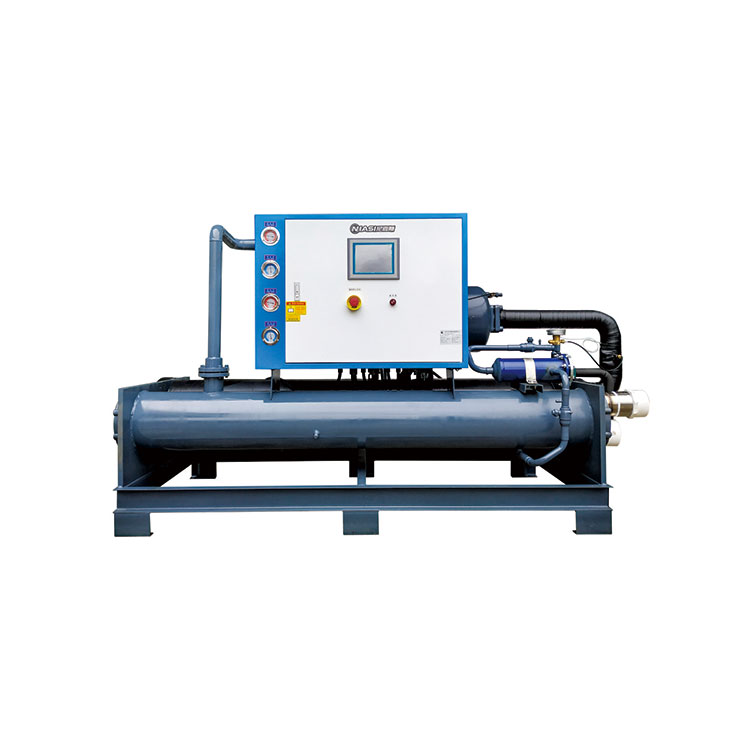
A standard water chiller consists of several core components working together:
| Component | Function |
|---|---|
| Compressor | Circulates refrigerant and raises pressure to enable heat release |
| Evaporator | Absorbs heat from the process water |
| Condenser | Releases absorbed heat to air or cooling water |
| Expansion Valve | Controls refrigerant flow and pressure |
| Control System | Monitors temperature, pressure, and system safety |
Main Types of Water Chillers
Water chillers are commonly categorized based on heat rejection method and compressor type:
- Air-Cooled Water Chillers – Use ambient air to dissipate heat, suitable for locations with limited water supply
- Water-Cooled Water Chillers – Use cooling towers or external water sources, ideal for large-capacity systems
- Scroll Chillers – Compact and efficient for small to medium loads
- Screw Chillers – Designed for continuous, high-capacity industrial applications
Selecting the right type depends on environmental conditions, load stability, and installation constraints.
Application Scenarios Across Industries
Water chillers are widely applied across multiple sectors due to their adaptability and reliability:
- Plastic injection molding and extrusion
- Laser cutting and CNC machining
- Chemical processing and reactors
- Medical imaging and laboratory equipment
- Food and beverage processing
Companies such as Dongguan Niasi Plastic Machinery Co., Ltd. integrate water chiller systems into complete industrial solutions to ensure consistent thermal performance throughout the production cycle.
How to Choose the Right Water Chiller
Choosing a suitable water chiller requires evaluating both technical and operational factors:
- Required cooling capacity and heat load
- Target temperature range and precision
- Operating environment and ambient conditions
- Energy efficiency and long-term operating cost
- Ease of maintenance and system expandability
A well-matched system avoids oversizing or undersizing, both of which can lead to inefficiency and premature wear.
Operational Benefits and Long-Term Value
Investing in a high-quality water chiller delivers measurable operational benefits:
- Improved process stability and product consistency
- Reduced equipment failure caused by thermal stress
- Lower energy consumption through optimized cooling cycles
- Extended service life of core machinery
- Scalable cooling capacity for future expansion
Maintenance and Performance Optimization
Routine maintenance ensures long-term reliability and efficiency. Key practices include:
- Regular inspection of refrigerant pressure and flow
- Cleaning condensers and heat exchangers
- Monitoring water quality to prevent scaling or corrosion
- Calibrating temperature sensors and control systems
Preventive maintenance minimizes unexpected downtime and maintains consistent cooling output.
Frequently Asked Questions
What temperature range can a water chiller maintain?
Most industrial water chillers can maintain temperatures from 5°C to 35°C, with higher or lower ranges available for specialized applications.
Is a water chiller suitable for continuous operation?
Yes. Industrial-grade water chillers are designed for 24/7 operation under stable load conditions when properly maintained.
How does a water chiller differ from simple cooling fans?
Cooling fans only reduce ambient air temperature, while a water chiller actively removes heat from the process, providing precise and repeatable control.
Can one water chiller serve multiple machines?
A centralized water chiller system can support multiple machines if the total cooling load is correctly calculated.
Conclusion
A water chiller is not merely an auxiliary device but a critical component in achieving stable, efficient, and safe industrial operations. By addressing overheating, inefficiency, and process variability, it enables manufacturers to maintain consistent output while protecting valuable equipment. With professional solutions from Dongguan Niasi Plastic Machinery Co., Ltd., businesses can implement dependable cooling systems tailored to their operational needs.
If you are evaluating ways to enhance temperature control, reduce downtime, and improve overall process reliability, contact us today to explore a water chiller solution designed for your application and long-term growth.