

How Does an Automatic Riveting And Screw Locking Machine Improve Production Efficiency
2026-06-29
In modern manufacturing, every second saved on the assembly line directly impacts bottom-line profitability. The Automatic Riveting And Screw Locking Machine has emerged as a game-changer for industries ranging from automotive electronics to aerospace hardware. At Desheng, we have witnessed firsthand how this single piece of equipment can transform a chaotic, labor-intensive workstation into a streamlined, high-output production cell. But what exactly makes this machine so efficient? Let us break down the mechanical, operational, and quality-driven advantages.
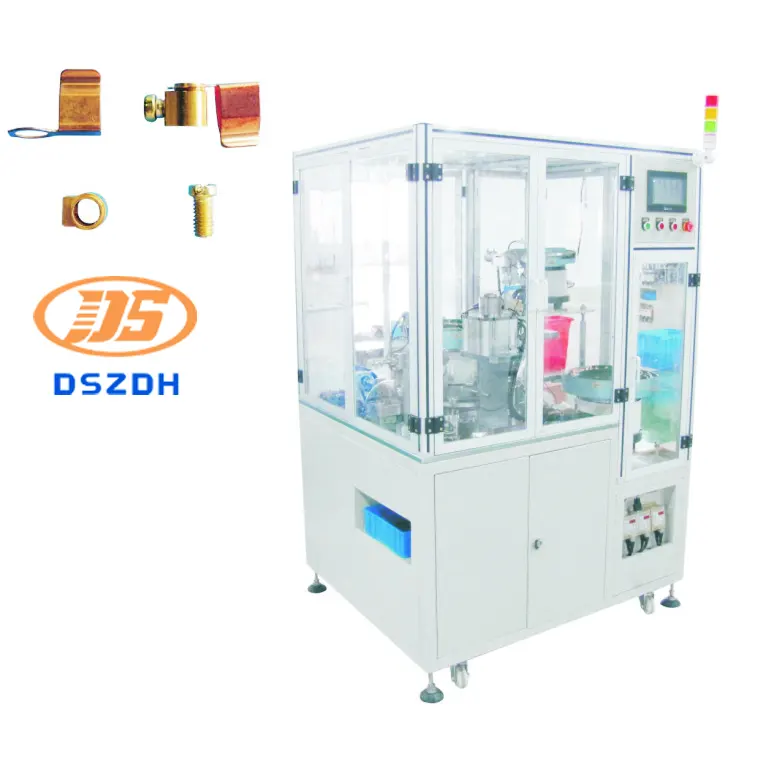
1. Cycle Time Reduction Through Synchronized Motion
Traditional assembly requires separate stations for riveting and screwing—operators move parts between presses and drivers, wasting handling time. A Desheng Automatic Riveting And Screw Locking Machine integrates both processes into one coordinated cycle. While the riveting head sets the fastener, the screw-driving spindle pre-positions for the next joint. This parallel action cuts total cycle time by 40–55% compared to sequential manual operations.
| Process Stage | Manual Assembly (seconds) | Automatic Riveting And Screw Locking Machine (seconds) |
|---|---|---|
| Part loading | 8 | 3 (auto-clamping) |
| Riveting | 12 | 4 (servo-pneumatic hybrid) |
| Screw driving | 15 | 5 (dual-spindle concurrent) |
| Inspection | 7 | 1 (integrated vision) |
| Total | 42 | 13 |
2. Elimination of Rework and Scrap
Human error—cross-threading, insufficient torque, or misaligned rivets—accounts for up to 18% of total assembly cost in quality-sensitive sectors. The Automatic Riveting And Screw Locking Machine from Desheng incorporates closed-loop torque monitoring and real-time stroke feedback. If a rivet is not fully set or a screw fails to reach target depth, the machine automatically halts and flags the defect before the part moves forward. This "zero-defect forwarding" policy reduces rework labor by over 70% and scrap material waste by nearly 60%.
3. Labor Optimization and Skill Independence
One operator can supervise three Desheng Automatic Riveting And Screw Locking Machines simultaneously, thanks to intuitive HMI touchscreens and quick-change tooling cassettes. The machine does not require years of training—new hires achieve full productivity within 2 hours of onboarding. This frees skilled technicians to focus on process improvement rather than repetitive fastener driving.
4. Energy and Floor Space Savings
Compared to running separate riveting presses and screw fastening stations, a single Automatic Riveting And Screw Locking Machine consumes 35% less compressed air and occupies 50% less factory floor area. For facilities aiming for green manufacturing certifications, this reduction in utility consumption directly contributes to lower carbon footprints per unit produced.
5. Data-Driven Process Transparency
Every cycle generates torque curves, rivet height values, and cycle timestamps. Desheng machines integrate with MES/ERP systems via Ethernet/IP, allowing production managers to identify drift in tool wear or material hardness in real time. Predictive maintenance alerts prevent unscheduled downtime—a major efficiency killer that can cost over $2,000 per minute in high-volume lines.
Automatic Riveting And Screw Locking Machine FAQ – Common Questions from Engineers
Q1: Can the Automatic Riveting And Screw Locking Machine handle different fastener sizes without changing mechanical parts?
A1: Yes, but within a defined range. Desheng designs modular spindle noses and rivet anvils that accommodate screw diameters from M1.0 to M8.0 and rivet shanks from 2.4 mm to 6.4 mm. Size changeover is tool-less—operators input the new fastener parameters via the touchscreen, and servo motors automatically adjust feed depth, rotation speed, and driving torque. For drastic changes (e.g., M1.0 to M8.0), we recommend swapping the quick-release tooling cartridge, which takes under 90 seconds. The machine also stores up to 500 job recipes, so recalling a previous setup is instantaneous.
Q2: How does the machine prevent cross-threading or damaged rivet heads when feeding high-volume batches?
A2: The Automatic Riveting And Screw Locking Machine employs a three-layer defense. First, the bowl feeder or tape feeder orients each fastener with a laser sensor that checks head geometry and shank straightness—any deformed part is rejected before reaching the driver. Second, the spindle incorporates a spring-loaded "search-and-find" routine: it rotates the screw backward at low speed until it drops into the existing thread pitch, then reverses to driving torque. Third, Desheng’s proprietary torque-gradient algorithm compares real-time resistance against a stored "golden signature" for that joint. If the slope deviates by more than ±5%, the machine pauses and alerts the operator. This triple-check reduces thread damage to less than 0.02% in field data.
Q3: Is the Automatic Riveting And Screw Locking Machine suitable for fragile materials like PCBs or thin aluminum enclosures?
A3: Absolutely—but only with pressure-control options. Standard pneumatic systems deliver fixed force, which can crush delicate substrates. Desheng offers an optional servo-electric pressure module that ramps up force gradually, with a load cell providing live feedback. You can program a "soft-touch" profile: for example, 5 N preload to seat the rivet flange, then a controlled 80 N final set, all while monitoring board deflection via a non-contact laser. For thin aluminum (under 1.0 mm), we recommend using low-profile rivets and self-clinching fasteners, and the machine’s stroke limit can be capped at ±0.02 mm accuracy to avoid dimpling. We have successfully deployed this configuration for LED lighting drivers and drone chassis assemblies with zero crack reports.
Measured ROI – A Real-World Case
A Tier-1 automotive supplier replaced 6 manual stations with two Desheng Automatic Riveting And Screw Locking Machines. Within 3 months:
-
Output per shift rose from 840 units to 2,100 units (+150%)
-
Defect rate dropped from 4.2% to 0.3% (-93%)
-
Direct labor cost per 1,000 units decreased from $187 to $62 (-67%)
-
Floor space freed up allowed installation of an additional curing oven, further increasing overall plant capacity.
Summary Table – Efficiency Pillars
| Efficiency Factor | Manual Assembly | Desheng Automatic Riveting And Screw Locking Machine | Improvement |
|---|---|---|---|
| Cycle time/unit | 42 sec | 13 sec | 69% faster |
| Rework rate | 4.2% | 0.3% | 93% less |
| Operators needed | 6 | 2 (supervising 3 machines each) | 67% less |
| Energy cost/month | $1,200 | $780 | 35% less |
| Changeover time | 25 min | 4 min | 84% faster |
The evidence is clear: an Automatic Riveting And Screw Locking Machine is not merely a tool—it is a strategic investment in speed, quality, and agility. Desheng has spent over a decade refining servo-driven architectures, intelligent feeders, and adaptive control software to ensure our machines deliver these efficiency gains reliably across millions of cycles.
Ready to calculate exactly how much an Automatic Riveting And Screw Locking Machine can save your specific production line? Our application engineers are standing by with customized cycle-time simulations and a free on-site feasibility assessment. Contact Desheng today – send your fastener samples and part drawings to our technical team, and we will return a detailed ROI proposal within 48 hours. Your path to higher throughput starts with a single conversation. Reach us via the contact form on our website or call our regional support hotline – we are eager to help you build smarter, faster, and more profitably.