

How Does Spindle Power Influence Machining Performance in a Large Gantry Machining Center
2026-04-02
When evaluating a Large Gantry Machining Center, one of the most critical yet often misunderstood specifications is spindle power. For industries such as aerospace, energy, and heavy mold manufacturing, the spindle is not merely a rotating component—it is the heart of the machine’s capability. At Bodiao, we have observed that understanding the relationship between spindle power and machining performance directly correlates with productivity, surface quality, and long-term operational costs.
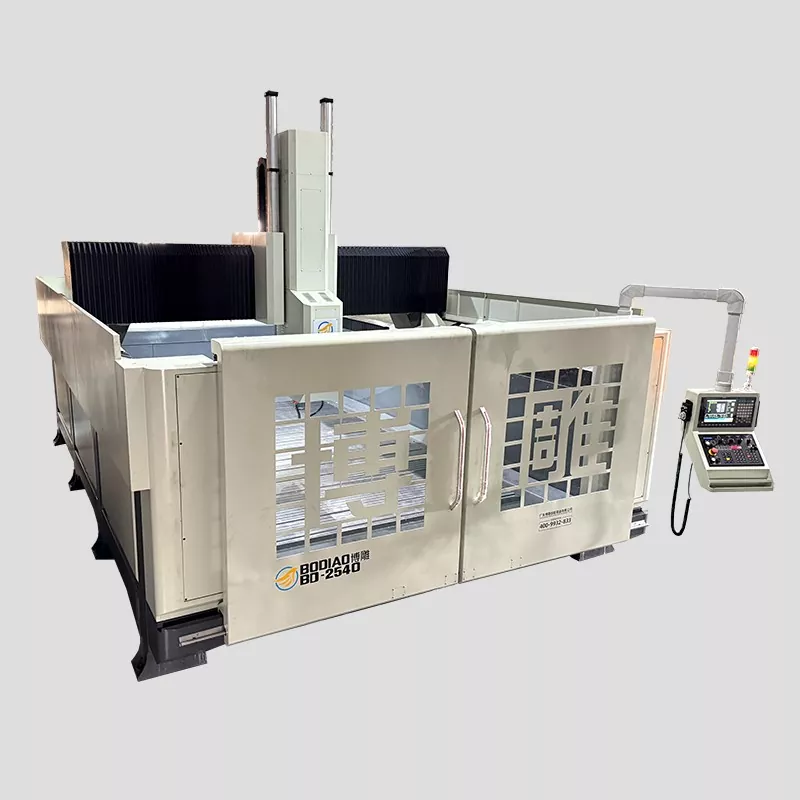
Spindle power in a Large Gantry Machining Center determines how effectively the machine can remove material, maintain precision under load, and adapt to varying tooling requirements. Low-power spindles may suffice for light alloys, but when processing hardened steel, titanium, or Inconel, insufficient power leads to chatter, reduced feed rates, and premature tool failure. Higher spindle power enables deeper cuts, higher metal removal rates, and consistent thermal stability—factors that directly impact cycle times and part accuracy.
To illustrate the influence of spindle power across different machining scenarios, the following table outlines key performance parameters:
| Parameter | Low Spindle Power (15–30 kW) | High Spindle Power (40–80+ kW) |
|---|---|---|
| Material Suitability | Aluminum, plastics, mild steel | Titanium, stainless steel, hardened alloys |
| Metal Removal Rate | Moderate, limited by torque | High, sustained heavy cutting |
| Surface Finish | Prone to vibration at depth | Superior finish due to rigidity and stability |
| Tool Life | Increased wear under load | Extended tool life with consistent cutting force |
| Application Scope | Prototyping, light production | Aerospace structural parts, heavy dies, large molds |
In practice, a Large Gantry Machining Center with optimized spindle power delivers tangible benefits. For instance, in aerospace stringer machining, higher spindle power allows for aggressive roughing passes without compromising precision during finishing. Similarly, in automotive die manufacturing, consistent torque at low RPMs ensures that hardened steel cavities are machined in fewer setups with tighter tolerances.
Bodiao integrates advanced spindle technology into its Large Gantry Machining Center series, ensuring that power curves are matched to real-world cutting demands. By combining high torque with thermal management systems, Bodiao machines maintain accuracy even during extended high-load operations.
Large Gantry Machining Center FAQ
What spindle power range is ideal for heavy-duty machining of titanium and stainless steel?
For heavy-duty applications involving titanium, stainless steel, or other high-temperature alloys, a Large Gantry Machining Center should typically offer spindle power in the range of 50 kW to 80 kW or higher. This power level ensures sufficient torque at low spindle speeds—often below 1,500 RPM—where these materials require high cutting forces. Additionally, a spindle with a wide constant-power band allows the machine to maintain material removal rates without frequent speed adjustments, reducing cycle times and preventing work hardening. Bodiao recommends evaluating both continuous and peak power ratings, as peak power supports intermittent heavy cuts while continuous power sustains long-duration roughing operations.
How does spindle power affect surface finish and accuracy in large gantry machining centers
Spindle power indirectly influences surface finish and accuracy by determining how well the Large Gantry Machining Center can maintain stable cutting conditions. When spindle power is insufficient, the machine may experience speed drop under load, leading to vibration, chatter, and dimensional inaccuracies. Conversely, a high-power spindle with adequate torque reserve allows for consistent tool engagement, especially during corner milling or contouring. This stability preserves the geometric integrity of large workpieces and reduces post-processing handwork. Bodiao emphasizes that a well-matched spindle power ensures that accuracy is not sacrificed for productivity, particularly in long-run machining of complex components.
Can a large gantry machining center with moderate spindle power still handle hard materials through advanced toolpath strategies
Yes, a Large Gantry Machining Center with moderate spindle power can still machine hard materials by employing advanced toolpath strategies such as high-efficiency milling (HEM) or trochoidal milling. These techniques maintain a constant chip load and reduce radial engagement, which lowers the peak torque demand on the spindle. However, this approach often extends cycle times and requires sophisticated CNC controls to optimize feed rates dynamically. For manufacturers seeking maximum throughput, investing in a Bodiao Large Gantry Machining Center with higher spindle power provides the flexibility to combine aggressive roughing with high-speed finishing, eliminating the need to compromise between capability and efficiency.
Selecting the right spindle power for a Large Gantry Machining Center is not solely about peak performance—it is about matching the machine to your production environment, material mix, and long-term growth. An undersized spindle leads to bottlenecks; an oversized but poorly integrated spindle adds unnecessary cost. With Bodiao, every Large Gantry Machining Center is engineered to deliver balanced spindle performance, structural rigidity, and application-specific customization.
For manufacturers aiming to enhance machining efficiency, reduce cycle times, and achieve consistent part quality, the choice of spindle power remains one of the most impactful decisions.
Contact us today to discuss your specific application requirements. Our engineering team at Bodiao is ready to help you configure the ideal Large Gantry Machining Center solution for your production goals.