

How Does Tube Wall Thickness Affect the Performance of a One-Line Finned Aluminum Tube Shrinking Machine
2026-04-07
When manufacturers evaluate a One-Line Finned Aluminum Tube Shrinking Machine, one critical yet often overlooked variable is tube wall thickness. At Feihong, extensive field testing reveals that wall thickness directly influences forming accuracy, tooling wear, and final product integrity. Understanding this relationship helps producers optimize output while minimizing downtime.
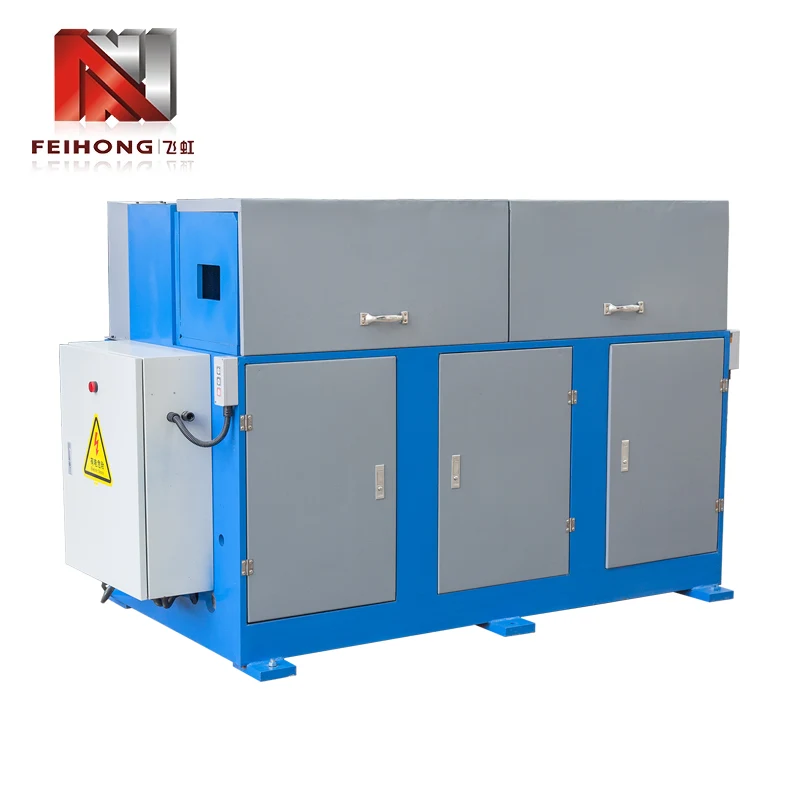
The Core Relationship: Thickness vs. Machine Performance
| Wall Thickness Range | Shrinking Force Required | Surface Quality | Tooling Life | Recommended Speed |
|---|---|---|---|---|
| 0.8 – 1.2 mm | Low to medium | Excellent | Long (500+ hrs) | 12–15 m/min |
| 1.3 – 1.8 mm | Medium to high | Good | Moderate (300–500 hrs) | 8–10 m/min |
| 1.9 – 2.5 mm | Very high | Risk of scoring | Short (under 200 hrs) | 5–7 m/min |
Thinner walls (0.8–1.2 mm) allow the One-Line Finned Aluminum Tube Shrinking Machine to operate at higher speeds with consistent reduction ratios. Thicker walls demand greater radial force, increasing the risk of tube buckling or ovality unless feed rates are reduced.
Three Critical Effects of Increased Wall Thickness
-
Heat buildup – Thicker aluminum dissipates heat slower, raising die surface temperatures and accelerating lubricant breakdown.
-
Springback variation – Walls above 1.6 mm exhibit up to 15% more elastic recovery, requiring multiple shrinking passes.
-
Power consumption – A 0.5 mm thickness increase raises motor load by approximately 22% on standard Feihong models.
Practical Recommendations from Feihong
For optimal One-Line Finned Aluminum Tube Shrinking Machine performance, match wall thickness to application:
-
Thin-wall (≤1.2 mm) – Ideal for condenser coils and lightweight evaporators.
-
Medium-wall (1.3–1.6 mm) – Best for general HVAC and automotive heat exchangers.
-
Thick-wall (≥1.7 mm) – Requires slower speeds and reinforced tooling; consult Feihong engineering first.
FAQ: One-Line Finned Aluminum Tube Shrinking Machine
Question 1: Can the same One-Line Finned Aluminum Tube Shrinking Machine handle both thin and thick wall tubes without changing tooling?
Answer: No. While a One-Line Finned Aluminum Tube Shrinking Machine from Feihong includes adjustable die gaps, shifting from 1.0 mm to 2.0 mm wall thickness typically requires a different die set. Thick walls create higher radial stresses that standard dies cannot absorb, leading to premature cracking. Feihong offers quick-change die cartridges allowing a 10-minute switch between thickness ranges.
Question 2: How do I know if my tube wall thickness is causing excessive wear on the shrinking machine?
Answer: Monitor three signs: rising motor current (over 15% above baseline), visible chatter marks on the tube surface, and increased aluminum dust accumulation near the shrinking head. For a One-Line Finned Aluminum Tube Shrinking Machine running 1.8 mm wall tube, Feihong recommends checking die clearance every 4 production hours instead of the standard 8-hour interval. Premature lubricant darkening also indicates thickness-related overload.
Question 3: Can thinning the tube wall improve overall production speed without sacrificing quality?
Answer: Yes, within limits. Reducing wall thickness from 1.5 mm to 1.1 mm increases the maximum feed rate of a One-Line Finned Aluminum Tube Shrinking Machine by roughly 40%, based on Feihong lab tests. However, wall thickness cannot fall below the minimum required for burst pressure and fin bonding strength. Feihong provides a thickness-speed calculator with every machine to find the optimal balance for your specific alloy and tube diameter.
Conclusion
Tube wall thickness is not a secondary parameter—it is a primary driver of One-Line Finned Aluminum Tube Shrinking Machine efficiency, tooling cost, and product consistency. By matching thickness to operating parameters and using Feihong precision components, manufacturers reduce scrap by up to 18% and extend die life by 300+ hours.
Contact us today for a customized thickness-performance simulation. Feihong engineers will analyze your tube specifications and recommend the optimal setup for your One-Line Finned Aluminum Tube Shrinking Machine. Reach out via our website or request a free process audit—let’s shrink your costs together.