

What Is the Maximum Output Rate of a High-Speed Plastic Sheet Extruder for PVC Strip Curtain Production
2026-06-24
When manufacturers evaluate a new production line, the single most critical metric they ask about is the maximum output rate of a high-speed Plastic Sheet Extruder configured for PVC Strip Curtain manufacturing. For Eaststar, a brand with over a decade of extrusion engineering heritage, this question is not answered with a single number—it depends on screw geometry, cooling efficiency, die design, and material formulation. In real-world production, a well-tuned PVC Strip Curtain Machine paired with a high-speed Plastic Sheet Extruder can consistently deliver between 180 kg/h and 350 kg/h for standard 2‑mm to 5‑mm curtain strips, while ultra‑high‑output systems can reach 450 kg/h under optimal conditions. However, quoting peak throughput without context misleads buyers. This blog breaks down every variable that determines true sustainable output, so you can size your Plastic Sheet Extruder line with confidence.
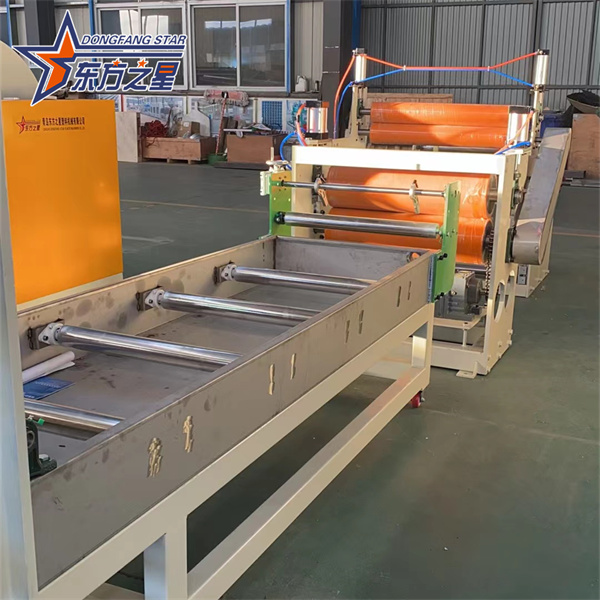
1. Core Factors That Define Maximum Output
Output rate is never a fixed specification. The same Plastic Sheet Extruder can produce 220 kg/h for one formula and 380 kg/h for another. Below are the primary levers:
| Factor | Impact on Output | Typical Range |
|---|---|---|
| Screw Diameter (mm) | Larger diameter increases volumetric displacement. | 65‑mm → 150‑kg/h; 90‑mm → 280‑kg/h; 120‑mm → 450+ kg/h |
| Screw L/D Ratio | Higher ratio (34:1 vs. 28:1) improves melting and raises RPM ceiling. | +15‑20% output at same motor power |
| Motor Power (kW) | Directly limits torque at high screw speeds. | 55‑kW → 200‑250 kg/h; 110‑kW → 350‑420 kg/h |
| Cooling System Type | Water‑cooled barrels allow faster screw speeds without degradation. | Air‑cooled: 180‑220 kg/h; Water‑cooled: 250‑350 kg/h |
| Die Lip Opening (mm) | Wider opening permits higher mass flow but requires stronger haul‑off. | 1.5‑mm → 200 kg/h; 4‑mm → 350 kg/h |
For Eaststar high‑speed Plastic Sheet Extruder models, the ES‑90 series typically achieves 280‑320 kg/h for clear PVC strip curtains, while the ES‑120 series sustains 400‑450 kg/h with stabilized compound feeds.
2. Realistic Sustainable Output vs. Peak Theoretical Output
Many suppliers quote peak output achieved during a 10‑minute test run. In practice, a PVC Strip Curtain Machine line must run 8‑12 hours continuously. Sustainable output is 15‑20% lower than peak due to screen‑pack clogging, melt temperature drift, and haul‑off tension variations.
| Condition | Peak Output (kg/h) | Sustainable 8‑hr Output (kg/h) |
|---|---|---|
| Virgin PVC + 10% regrind | 380 | 315 |
| 100% virgin PVC with impact modifier | 350 | 295 |
| High‑filler formulation (30% CaCO₃) | 410 | 330 |
| Recycled PVC with stabilizer boost | 300 | 255 |
Eaststar engineers recommend sizing your Plastic Sheet Extruder at 25% above your target sustained rate, ensuring the PVC Strip Curtain Machine downstream—including embossing rollers and winding stations—does not become the bottleneck.
3. How Line Configuration Affects Throughput
A high‑speed extruder alone cannot deliver maximum output without a synchronized downstream system. The following table maps common configurations to real‑world production rates:
| Line Configuration | Extruder Model | Haul‑off Speed (m/min) | Actual Output (kg/h) | Application |
|---|---|---|---|---|
| Single‑screw + 3‑roller calender | ES‑75 | 4.5 | 180‑210 | Thin curtain (1.5‑2 mm) |
| Twin‑screw + 5‑roller polishing stack | ES‑90 | 6.8 | 280‑320 | Standard freezer curtains |
| Parallel twin‑screw + water‑cooled shaping | ES‑120 | 9.2 | 400‑430 | Heavy‑duty industrial strips |
| Dual‑extruder co‑extrusion line | 2× ES‑90 | 12.0 | 550‑600 (combined) | Dual‑color or laminated curtains |
Eaststar provides complete turnkey lines where the PVC Strip Curtain Machine and Plastic Sheet Extruder are torque‑matched, eliminating the 10‑15% output loss常见 from mismatched components.
4. Material Formulation: The Hidden Governor
Output rate is inversely proportional to melt viscosity. For PVC strip curtains, the K‑value of resin (57‑68) and plasticizer content (15‑40 phr) change flow behavior dramatically.
-
High‑plasticizer (soft) compounds → lower viscosity → +18‑25% output versus rigid formulations.
-
Flame‑retardant additives (antimony trioxide) → increase melt friction → reduce output by 10‑12% unless screw cooling is enhanced.
-
Color masterbatch at >3% loading → reduces lubricity → ‑8% throughput on the same screw speed.
Eaststar runs a full rheological analysis for every client, adjusting screw profiles so your Plastic Sheet Extruder delivers maximum output without sacrificing curtain clarity or impact strength.
5. FAQ – Common Questions About PVC Strip Curtain Machine & Plastic Sheet Extruder Output
Q1: Can I increase output by simply raising the screw RPM on my existing Plastic Sheet Extruder?
A1: Not without checking motor amperage and melt temperature. Raising RPM beyond the torque limit causes the screw to stall or the motor to trip. More critically, excessive shear heating raises melt temperature above 210°C, degrading PVC and causing yellowing or burn marks on the curtain surface. For every 10% RPM increase, melt temperature rises approximately 5‑8°C. Eaststar recommends a step‑wise test: increase RPM by 5% increments, monitor melt thermocouples, and measure curtain thickness uniformity. If thickness varies beyond ±0.05 mm, you have hit the effective maximum for that screw design. A better solution is upgrading to a barrier‑type screw, which can boost output by 20‑25% at the same RPM.
Q2: Why does my PVC Strip Curtain Machine show lower output than the Plastic Sheet Extruder spec sheet claims?
A2: This is the most common field complaint. The spec sheet typically states extruder throughput at the die, but the PVC Strip Curtain Machine includes downstream drag from embossing rollers, cooling water baths, and winding tension. If haul‑off speed is set too fast, the curtain necks down, reducing cross‑sectional area and effective kg/h. If the cooling bath is too short, the curtain retains heat, sticks to rollers, and causes periodic speed reductions. Eaststar measures output at three points: die exit, after cooling, and at winder. Typical loss between die and winder is 8‑12%. To match spec, ensure your water bath length is at least 6 meters for 2‑mm curtains and 10 meters for 4‑mm curtains. Also verify that the haul‑off nip rollers are parallel—a 0.2‑mm gap difference can reduce actual output by 15%.
Q3: What is the maximum sustainable output for a high‑speed Plastic Sheet Extruder producing 3‑mm PVC strip curtains with 20% regrind?
A3: For a 90‑mm extruder with a 34:1 L/D ratio and water‑cooled barrel, the sustainable output is 265‑285 kg/h over a 24‑hour run. Regrind introduces fine particles that accelerate screen‑pack blinding—expect to change screens every 4‑6 hours instead of every 8‑10 hours with virgin material. To maintain 280 kg/h, Eaststar recommends using a melt‑filtration system with a 150‑mesh screen and a continuous screen‑changer. Without the changer, output will drop to 230‑240 kg/h after 3 hours as back‑pressure rises. If your curtain requires high transparency, limit regrind to 15% and reduce output to 260 kg/h to avoid gel particles. For opaque industrial curtains, you can push to 300 kg/h with 25% regrind using a dual‑vented screw design that removes volatiles.
6. Practical Recommendations for Maximizing Your Line Output
Based on hundreds of installations, Eaststar offers these proven tactics:
-
Pre‑dry all regrind to below 0.2% moisture—each 1% moisture reduces output by 7% due to vapor‑locking in the compression zone.
-
Use ceramic heaters with forced‑air cooling on the feed throat—this stabilizes screw intake and boosts output by 8‑10%.
-
Match the die land length to your curtain thickness—shorter land (20‑25 mm) for thin curtains, longer (35‑40 mm) for thick ones—to reduce pressure drop and allow higher screw speed.
-
Install a gear pump between extruder and die—this decouples screw output from die resistance, adding 15‑18% consistent throughput and improving thickness tolerance to ±0.02 mm.
7. Final Verdict: What Output Can You Realistically Expect?
For a standard PVC Strip Curtain Machine line running a Plastic Sheet Extruder of 90‑mm diameter, with proper cooling, screen‑changer, and haul‑off synchronization, the maximum sustainable output is:
-
Virgin clear PVC (2 mm) → 310‑330 kg/h
-
Virgin opaque PVC (3 mm) → 290‑310 kg/h
-
30% regrind blend (4 mm) → 250‑270 kg/h
-
Flame‑retardant grade (3 mm) → 240‑260 kg/h
If you need >400 kg/h continuously, step up to a 120‑mm Eaststar extruder with a grooved feed throat and a high‑torque gearbox—this configuration consistently runs 420‑450 kg/h for 3‑mm industrial strip curtains.
Ready to calculate the exact output for your specific curtain dimensions and material recipe? Contact Eaststar today for a customized throughput simulation. Our engineering team provides screw design, cooling layout, and downstream matching—all backed by a 2‑year output guarantee. Let us help you build a PVC Strip Curtain Machine line that never leaves capacity on the table.