

Why Is Fiber Continuity Key in a CNC Thread Rolling Machine?
2026-09-18
1. What Is the Difference Between Cut Threads and Rolled Threads?
Thread cutting removes material from a cylindrical blank. The cutting tool shears the metal, and the resulting thread has a grain structure that is interrupted at the thread root. The fibers that run longitudinally through the blank are severed. This interruption creates a stress concentration that reduces fatigue strength by 20 to 30 percent compared to a rolled thread. Thread rolling, by contrast, does not remove material. The CNC Thread Rolling Machine presses the blank between two or three dies that have the reverse image of the thread. The material is displaced plastically and flows into the die cavities. The grain flow follows the contour of the thread root, and the fibers remain continuous. This continuous grain flow is what gives rolled threads their superior fatigue resistance and load carrying capacity.
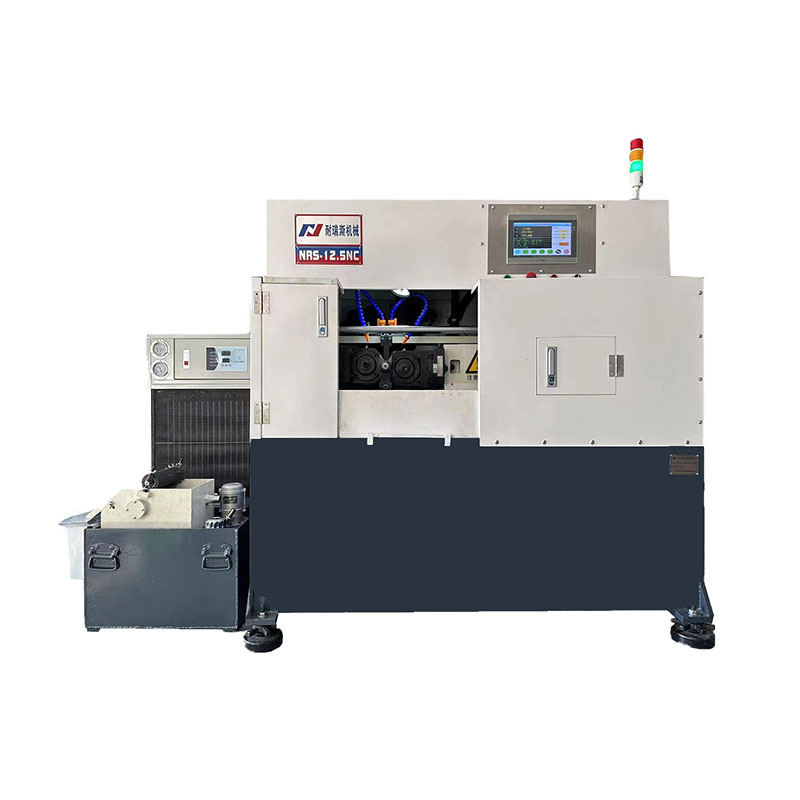
The table below compares the mechanical properties of cut and rolled threads.
| Property | Cut threads | Rolled threads (CNC thread rolling) | Improvement |
| Grain flow continuity | Interrupted at root | Continuous around root | Eliminates stress concentration |
| Fatigue strength (MPa) | 180 – 220 | 250 – 320 | 30 – 45% higher |
| Tensile strength (MPa) | 700 – 800 | 850 – 950 | 15 – 20% higher |
| Surface finish (Ra, µm) | 3.2 – 6.3 | 0.8 – 1.6 | Smoother, better corrosion resistance |
| Material waste | 20 – 30% chips | Zero chips | Material saving |
Dongguan Neres Hardware Machinery Co.,Ltd. manufactures CNC Thread Rolling Machine units that are designed to maximize fiber continuity by controlling the rolling force, the die speed, and the material temperature. Our factory has conducted metallographic studies on thousands of threaded fasteners to verify the grain flow pattern.
2. How Does the CNC Thread Rolling Machine Create Continuous Fiber Flow?
The fiber continuity in a rolled thread is created by the plastic deformation of the material. As the dies press into the blank, the material flows outward and upward to fill the die cavities. The fibers that were originally parallel to the axis of the blank are bent to follow the contour of the thread. The key to achieving continuous fiber flow is to control the rate and direction of the plastic deformation. If the deformation is too rapid, the material may tear or develop micro-cracks. If it is too slow, the material may work-harden excessively and become brittle. The CNC Thread Rolling Machine controls the deformation by adjusting three parameters: the radial feed rate, the die rotation speed, and the cooling lubricant flow. The table below shows the optimal parameters for different materials.
| Material | Radial feed rate (mm/rev) | Die speed (RPM) | Lubricant flow (L/min) | Fiber continuity result |
| Carbon steel (1022) | 0.8 – 1.2 | 120 – 180 | 8 – 12 | Continuous, no tears |
| Alloy steel (4140) | 0.5 – 0.8 | 90 – 140 | 10 – 15 | Continuous, slight work hardening |
| Stainless steel (304) | 0.3 – 0.6 | 60 – 100 | 15 – 20 | Continuous, requires high lubrication |
| Titanium (Ti-6Al-4V) | 0.2 – 0.4 | 40 – 70 | 20 – 25 | Continuous, requires pre-heating |
In our factory, we use a servo-driven radial feed system that maintains a constant feed rate throughout the rolling cycle. This prevents the sudden changes in deformation rate that can cause fiber interruption. We also use a high-pressure coolant system that delivers lubricant directly to the deformation zone to reduce friction and heat.
3. What Causes Fiber Discontinuity in Thread Rolling and How Is It Detected?
Fiber discontinuity in a rolled thread can be caused by four factors. The first is an incorrect blank diameter. If the blank is too small, the dies cannot fill the thread crest, and the fiber flow is incomplete. If the blank is too large, the dies may overfill the thread and cause laps or folds. The second is excessive rolling speed. High speed generates heat that can cause the material to flow unevenly. The third is inadequate lubrication. Friction between the dies and the material can cause surface tearing and fiber interruption. The fourth is worn dies. Worn dies have rounded crests that do not displace the material efficiently, leading to incomplete fiber flow. Detection of fiber discontinuity is typically performed by metallographic examination. A cross-section of the thread is polished and etched to reveal the grain structure. The fibers should follow the thread contour without interruption. If the fibers are cut or folded, the thread is defective. The table below shows the acceptance criteria for fiber continuity in different thread classes.
| Thread class | Fiber continuity requirement | Maximum allowable interruption length | Typical application |
| Class 4.8 | Moderate | 0.5 mm | General purpose |
| Class 8.8 | Good | 0.2 mm | Automotive, machinery |
| Class 10.9 | High | 0.1 mm | High stress applications |
| Class 12.9 | Very high | 0.05 mm | Aerospace, critical joints |
Dongguan Neres Hardware Machinery Co.,Ltd. provides a metallographic inspection service for customers who need to verify the fiber continuity of their threaded products. Our factory also offers training on how to interpret the grain flow patterns.
4. How Does Fiber Continuity Affect the Fatigue Life of a Threaded Fastener?
Fatigue failure is the most common mode of failure for threaded fasteners in dynamic applications. The fatigue crack usually initiates at the thread root, where the stress concentration is highest. If the grain flow is continuous around the root, the stress is distributed along the fibers, and the crack initiation is delayed. If the grain flow is interrupted, the stress concentrates at the interruption, and the crack initiates earlier. The difference in fatigue life can be substantial. In our factory, we have conducted fatigue tests on cut and rolled threads of the same material and size. The rolled threads lasted 3 to 5 times longer than the cut threads under the same cyclic load. This is why rolled threads are specified for critical applications such as automotive suspension, engine connecting rods, and aerospace structures.
Frequently Asked Questions About Fiber Continuity in Thread Rolling
Summary for Fastener Production Engineers
Fiber continuity is the key to the strength and fatigue life of a rolled thread. The CNC Thread Rolling Machine creates continuous fiber flow by plastically deforming the material without cutting it. The continuity depends on the blank diameter, the rolling speed, the lubrication, and the die condition. Verification is performed by metallographic examination of the thread cross-section. For critical applications, the fiber continuity requirement becomes more stringent, and the process must be controlled more precisely. Dongguan Neres Hardware Machinery Co.,Ltd. has been manufacturing CNC Thread Rolling Machine units for over 15 years and supplies to fastener manufacturers worldwide.
Dongguan Neres Hardware Machinery Co.,Ltd. manufactures CNC Thread Rolling Machine units with servo-controlled radial feed, high-pressure coolant systems, and die wear monitoring. We provide full technical specifications and process training for our customers.